Phantom Election Management Software
We have seen that Electronic Registration allows for the creation of phantom voters who appear to be casting phantom votes. But who are the "ghostwriters" of the software that manages election fraud?
8/6/202510 min read
Who is "Managing" Idaho's Elections?


This is the fourth in a series of articles exposing the problems with Electronic Voter Registration. Other articles include E-Registration Opens Door to Fraud, Digital ID and Phantom Voters and Data Collection Disguised.
We have already seen that Idaho’s Electronic Voter Registration program allows for the creation of phantom voters, who appear to be casting phantom votes. But who actually writes the software that manages Idaho’s Voter Registration Lists and Poll Books? It’s not who you think.
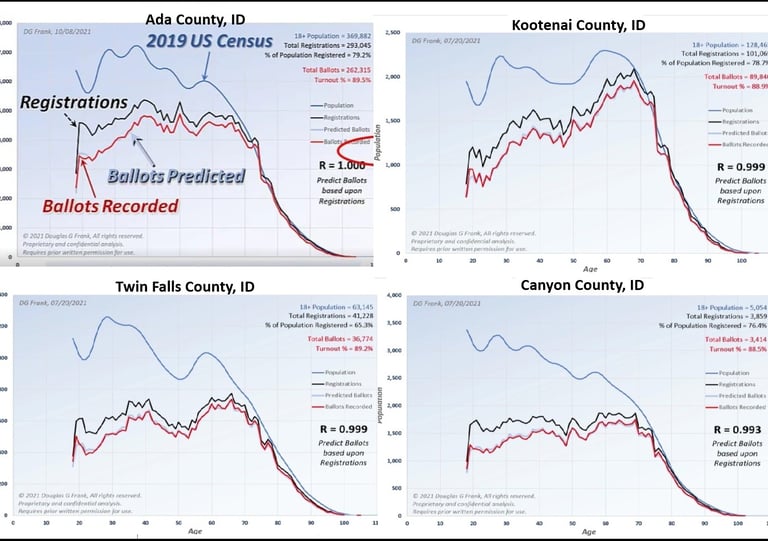
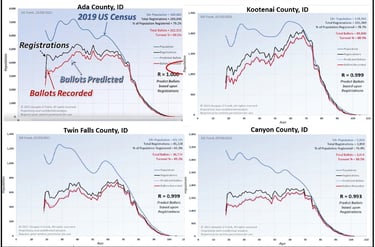
According to Dr. Frank’s analysis of Idaho’s 2020 election it appeared that both registrations and ballots cast were inflated, and they tracked each other so closely (when organized by voter age) that Dr. Frank was able to predict, with almost perfect accuracy, how many ballots were cast for each age cohort. How can that happen? It is hard to avoid the conclusion that computerized fraud is involved, and that the system is set up to allow bad actors to steal elections.
But what software program possibly could do this? It is easy to show how phantom voters could be added to voter rolls in predictable patterns by a computer algorithm. But rigging an election by inserting phantom ballots without getting caught is far more complicated. Many numbers must add up. The number of ballots cast and counted in each precinct must match poll book numbers and the tabulator must produce ballot images and CVRs that match up as well.
Many different software programs running at different times, on different computers from different vendors, would all have to be working together. How is it possible that all this could be perfectly coordinated?
And if Dr. Frank is correct, his data tells us that the whole fraudulent system, from voter registration to polling data, to tabulation, to election night reporting, must be coordinated “top down” nationwide. The problem could not be as simple as a “rogue tabulator” or it would certainly be caught.
Could Idaho be involved in a system of nationalized, top-down election fraud? We need to consider the possibility. And if it is, then it seems that Election Management software running in Idaho’s SOS office would have to be involved.
Tenex Selected to Manage Idaho Elections
None of these tasks are rocket science. Most are simple data management tasks that could be handled by spreadsheets and off-the-shelf office management software. Instead they have been centralized and automated. Centralization and automation reduces the need for routine data management office work, but it also reduces transparency and accountability.
Centralizing all these tools into one system makes it far easier for bad actors to commit and cover up fraud. All these tools access the same database of registered voters. Electronic pollbooks provide minute by minute status of exactly who has voted in every precinct. Inventory tracking manages chain-of-custody for ballot boxes, and “Ballot Printing” tools control and track print-on-demand ballots. Almost everything needed to orchestrate an election heist in one integrated program.
But what about tabulators? A tabulator requires specialized hardware and software, and Tenex does not support electronic tabulation tools. But like all electronic devices, tabulators are vulnerable to hacking, and in general, tabulator CPUs have access to an antenna, even if they are not "hooked up to the internet". The truth is, "the internet" is only one of numerous wireless protocol, any electronic device that has an antenna can communicate wirelessly with other computers in their vicinity. So it is not impossible that Tenex computers or pollbooks to communicate wirelessly with with tabulators.
What more does one need to “automate” election fraud, than centralized, computerized control of all aspects of elections? If fraud occurs, it is the machine, not the people in the elections office that are committing it, and the machines can easily cover their tracks.
It certainly seems that Tenex Software has access to every aspect of Idaho’s Election data. This does not mean that Tenex has coordinated election fraud in Idaho, but if Tenex software could be hacked by bad actors who wrote the software and know its vulnerabilities, it would certainly be a disaster for Election Integrity in Idaho.
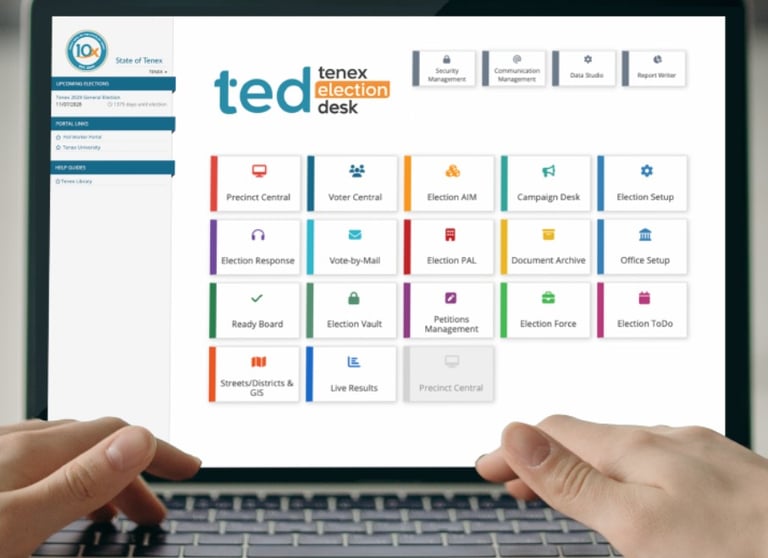
In 2018, Secretary of State Denney selected Tenex as the vendor for Idaho’s Election Management software. In addition to online voter registration software, Tenex provides software that handles election night reporting, campaign finance reporting, e-poll book management, election document archives, absentee ballot processing, and much more.
Tenex software can run at both the state and county level, and to some extent, each county can decide with features to uses. For example, some Idaho counties have other tools for county election reporting, and some of the smaller counties don't even use pollbooks. In theory, counties make their own decisions about what election software to use, but since 2019, when the complete Tenex system was certified by Idaho, more counties are moving to Tenex Software Solutions.
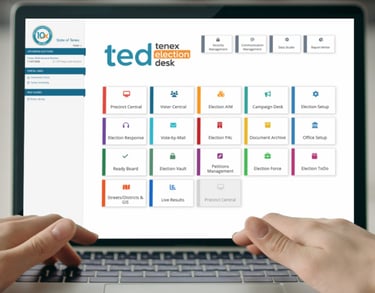
Electronic Poll books were not widely used in Idaho prior to the 2020 election, but they provide enormous amounts of information about how an election is proceeding in real time, and they have been adopted by most of the larger Idaho counties. Other common election management services provided by Tenex are listed below.
PB-Electronic Poll Book (usually based on an Apple or Microsoft Tablet)
VLM-Voter List Management, and Electronic Registration maintained at the state level.
EM-Election Management and Help Desk: Centralized election information for SOS and County Election Officials
ENR-Election Night Reporting : Tabulates incoming results and reports to Media and Public
AB-Absentee Ballot Management : Handles requests, mailing out, signature checks
AIM-Asset Inventory Management : Keeps track of poll books, ballot boxes, etc. Verifies "chain of custody".
BP-Ballot Printing : Manages lookup and control of “Print on Demand” ballots.
EW-Election Worker Management, and Online Training : Tracks status of all Election works at all precincts.
CF-Campaign Finance Reporting and Tracking : Allows public to view donations for all candidates.
DA-Document Archive : stores electronic data, and images from all past elections.
PP-Petition Processing : tracks signature verification for initiatives, recalls, etc.
This list gives an idea of how many tasks that were formerly done using COTS (commercial off the shelf), general purpose data management tools that have come under control of specialized, centralized Election Management software. Not all features are used by all counties in Idaho, but the SOS has access to all data that is processed by the Tenex system.
Who is Behind Tenex?
The point is, the Tenex election management system is extremely sophisticated and can be integrated with many government databases. And there is not good reason for this. House Bill 339 (passed in 2025), authorized the SOS to collect enormous amounts of personal data from various sources in or order to "verify the voter rolls", but instead of simply verifying the rolls, it appears the Tenex "Voter Central" tool allows for continuous data monitering. We pointed out the extremely serious problems allowing voter rolls to interlink with other government databases in the articles Data Collection Disguised as Election Integrity and Digital Elections, Digital Identities.
But there is another extremely alarming problem with Tenex that leads us to believe that Tenex is not actually the company that developed this the sophisticated and potentially compromised software it markets. And that is the fact, that it supports customers in 20 states and over 350 counties, but appears to employ only about 70+ people. How can this be?
It takes an enormous amount of time and resources to develop, test, and maintain this type of integrated database management software—software so important, and at such high risk of being hacked, that it is considered “critical infrastructure.” It would be impossible for a small company such as Tenex to develop and test all the software it sells. So it is almost certainly licensing its election management software from some other corporation.
Tenex is a systems integration company, not a software development company. It licenses software tools, bundles them with off-the-shelf hardware, and then does marketing, sales, and customer support. There is a significant amount of technical work involved in customizing Tenex products and integrating them into elections offices, so the Tenex workforce is highly skilled at what they do. But it is impossible that a company with 70 employees could produce, test, and maintain such complicated software. So Who Did???
Maybe its time to look more closely at Tenex Software Solutions. Like virtually all other election technology companies, Tenex is privately held and there is little information on its website about the company's history or owners or software development partners.
But there is a great deal of information about its products. We have already provided an overview of Tenex products, and its latest software products have a broad range of advanced features.
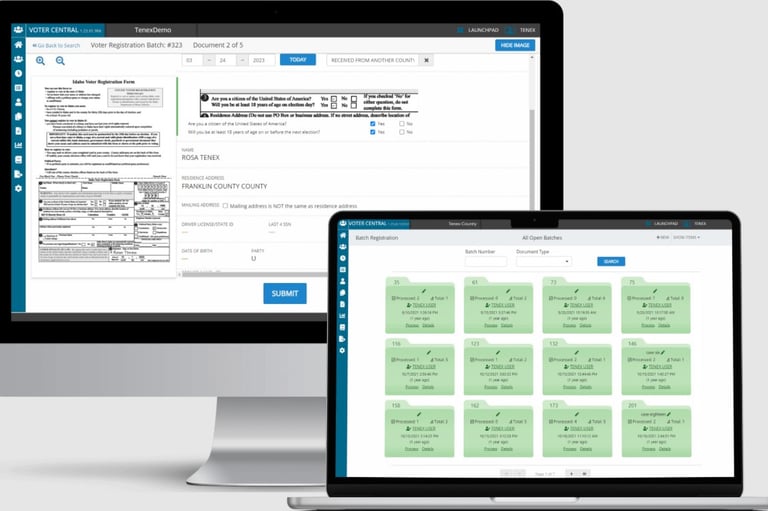
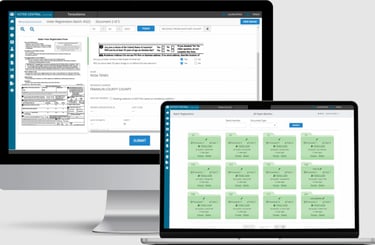
For example, this is a description of Tenex’s next generation of voter management tools. The program is clearly able to track much more data about voters, than is required to register to vote.
Tenex's Voter Central tool . . . "integrates with other agencies and information sources" . . . and "sources span API and file-based interfaces with the Department of Corrections, Vital Statistics, ERIC, DMV, USPS, and NCOA processors to verify voter changes..."
This means that Tenex voter registration software now has the ability to integrate all sorts of information about every Idaho voter, just as House Bill 339 mandates. And this implies that it is possible that whoever developed Tenex's Voter Roll Management software is also involved in implementing Digital Identification nation-wide.
Other Election Technology Vendors
The question we have to ask is, if Tenex did not write the election management software it is licensing to Idaho elections offices then who did?Maybe it is leasing software that some other company developed. What other ETC companies exist that might have the staff required to develop and test such advanced election management software? Let’s see how Tenex compares to other Election Technology Companies with similar products.
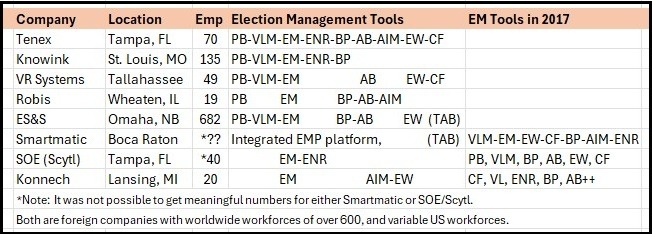
It seems that Tenex is not the only ETC company with a workforce that is too small to develop, test, maintain, and provide support to such complex Election Management tools. This brings to mind a few questions and points worth noting.
1) All electronic technology companies are privately held. Not a single one is publicly traded, and none of the large, publicly traded companies who write software for government agencies has an "elections" division. Why are ALL Election Technology companies private? Could it be so they do not need to disclose any strategic partnerships, or proprietary technology, or unusual financial arrangements?
2) Many of the companies have very similar “Election Management” product lines, with similar features. And almost all are too small to have developed such advanced software independently. Could it be that some of the ETC companies who offer Elecronic Poll Books and Election Management Tools are leasing their software from the same company? Could it be that the company that developed these sophisticated tools wants to create the "illusion of choice" so their monopoly over Election Management software is not obvious?
3) ES&S and Smartmatic are the only two companies that offer both Tabulators and electronic Poll book products. This is relevant because if one was going to provide a platform for an undetectable system of computerized election fraud, which could manipulate ballot counts and ballot images, produce consistent results, and cover all its tracks, tabulator software would need to be “in on it.”
Note: The chart shown above has been updated to include the status of each company's Election Management tools as of 2017. When this article was first written we only considered the EM tools available from each company as of 2025. Since several companies (especially SOE/Scytle) no longer offer products they were first-to-the-market with, this made it difficult to determine who really developed Tenex's tools. However, when you consider the state of all EM software companies as of 2015-2018, it becomes obvious that Scytl was almost certainly the developer. More evidence of this is presented in a follow-up article, Foreign Entities Control Idaho Elections.
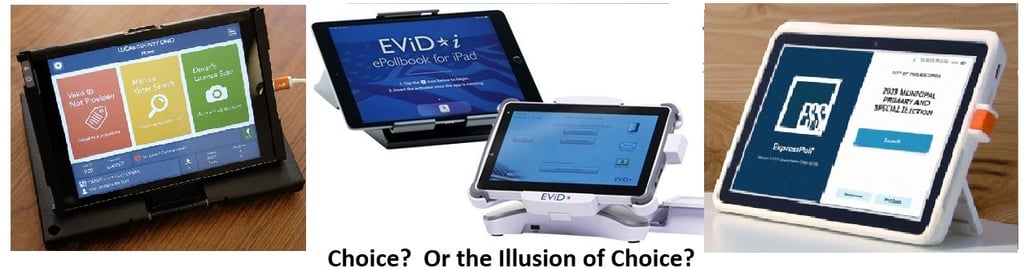
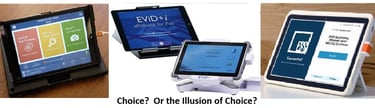
We are not speculating when we supposed that Tenex and other small companies are leasing much of their software from a larger ETC Company. Although Tenex does not mention anything about technology partners on their website, VR Systems does. VR systems has a product line almost identical to Tenex, and on their "partners" page they admit to "working closely with the best providers in the industry", and "providing service and IT support as well as manufacturing".
This seems to imply that software development was done elsewhere. Strangely, however, VR Systems fails to name its partners. We wonder why not. Could it be to preserve the illusion of choice?
Phantom Software, Phantom Voters, Phantom Votes
It is possible that almost all elections offices in the United States could be running customized versions of the same hackable Election Management software, unbeknownst to election officials. If so, it would not be "many different" software programs. It would be one integrated program designed to control every aspect of every election in every county in the United States.
The thing that makes sophisticated, high tech, computerized election fraud so dangerous, is that it is almost undetectable. It is the machine, rather than election officials, which does the cheating, so everyone has plausible deniability. The people who use Election Management software, the politicians who support computerized elections, and even employees of Election Technology Companies may be entirely unaware the software is capable of modifying election results. Or some of them could know what is going on. It is impossible to determine who knows what.
Computerized election fraud is the “perfect crime” and the “victims” are the unsuspecting public who believe they are participating in free and fair elections.
We have now concluded that there is overwhelming evidence that a Scytl, a Spanish company, was the developer of Tenex's tools. (See our follow up article on Foreign Entities). But what other companies might also be leasing their software from Scytl? It is impossible to know for certain, but if all ETCs offering centralized Election Management tools have integrated the same software into their products, this could explain the alarming signs of election fraud across almost all states—including Idaho—that Dr. Frank discovered in his analysis of the 2020 election.
As we have said before, almost all software has “backdoors” that are known only to those who wrote the source code. So if almost all election offices in the United States are running the same software—just packaged into different products—and if that software could be “hacked” this could explain what appears to be impossible coordination between "independent" software tools.




Empowering Voters
Advocating for transparent, honest, and decentralized voting systems.
Please subscribe to the Eye on Elections Newsletter.
Contact us:
© 2025. All rights reserved.